
Every year around now, Montreal fills up with two overlapping crowds: students landing for the fall semester with a lease that doesn't start yet, and backpackers passing through on a route that ends somewhere else. Both are asking the same question — how do I stay somewhere cheap that isn't forty minutes from everything? Here's the honest answer, including the parts that cost more than people budget for.
The two arrival windows
If you're starting school, your problem is usually a gap: you fly in mid-August, the semester starts in early September, and your apartment isn't available until the first of the month — or you haven't signed anything yet, because signing a lease on photos from another continent is a bad idea. You need somewhere central for one to three weeks while you view places in person.
If you're backpacking, your problem is different: two to four nights, everything walkable, nothing wasted on a room you'll barely be in. You want the city, not the accommodation.
Different trips, same solution shape — pay for location and a lockable place to sleep, don't pay for square footage you won't use.
What "cheap" actually costs in Montreal
Montreal is genuinely one of the better-value big cities in North America, but a few things catch newcomers out:
- Tax is added at the till. Prices on menus and shelves are pre-tax; expect roughly 15% on top at checkout. Budget accordingly — the CA$12 sandwich is closer to CA$14.
- Tipping is expected in sit-down restaurants and bars, typically 15–20% on the pre-tax total. It's real money over a week.
- Transit is cheap but not free. The STM runs the metro and buses, and there are reduced fares for registered students — check the STM site for current rates and what documentation you need, since eligibility rules change.
- Groceries beat restaurants by a mile if you have a kitchen. This is the single biggest lever on a long stay.
The cheapest bed forty minutes away is not cheaper than a central one once you count two transit legs a day and the taxi you take at 1am.
Where to base yourself: the university geography
Montreal's campuses are not in one place, so "close to school" depends on which school.
Downtown is the dense one: Concordia's downtown campus, McGill a short walk east, and the Guy-Concordia and McGill metro stations feeding both. Our Capsule Residence Bishop is right in that quarter, which is why it's the one students book most — you can view apartments, do campus admin and buy a duvet all on foot in the same afternoon.
The Plateau and the Main is where a lot of student life actually happens after class — cheap food, second-hand shops, and an easy metro ride to UQAM. Our Capsule Hôtel Saint-Laurent sits on Boulevard Saint-Laurent in the middle of it. If you're deciding between neighborhoods before you commit to a lease, our neighborhood guide is the honest breakdown.
The Old Port is the tourist-facing one, closest to Old Montreal and the river — better suited to a backpacker's few nights than to a semester of commuting. Our Capsule Hôtel + Vieux-Port is opening there in 2026; until it does, Bishop and Saint-Laurent are the two you can book.
Why a capsule works for a landing
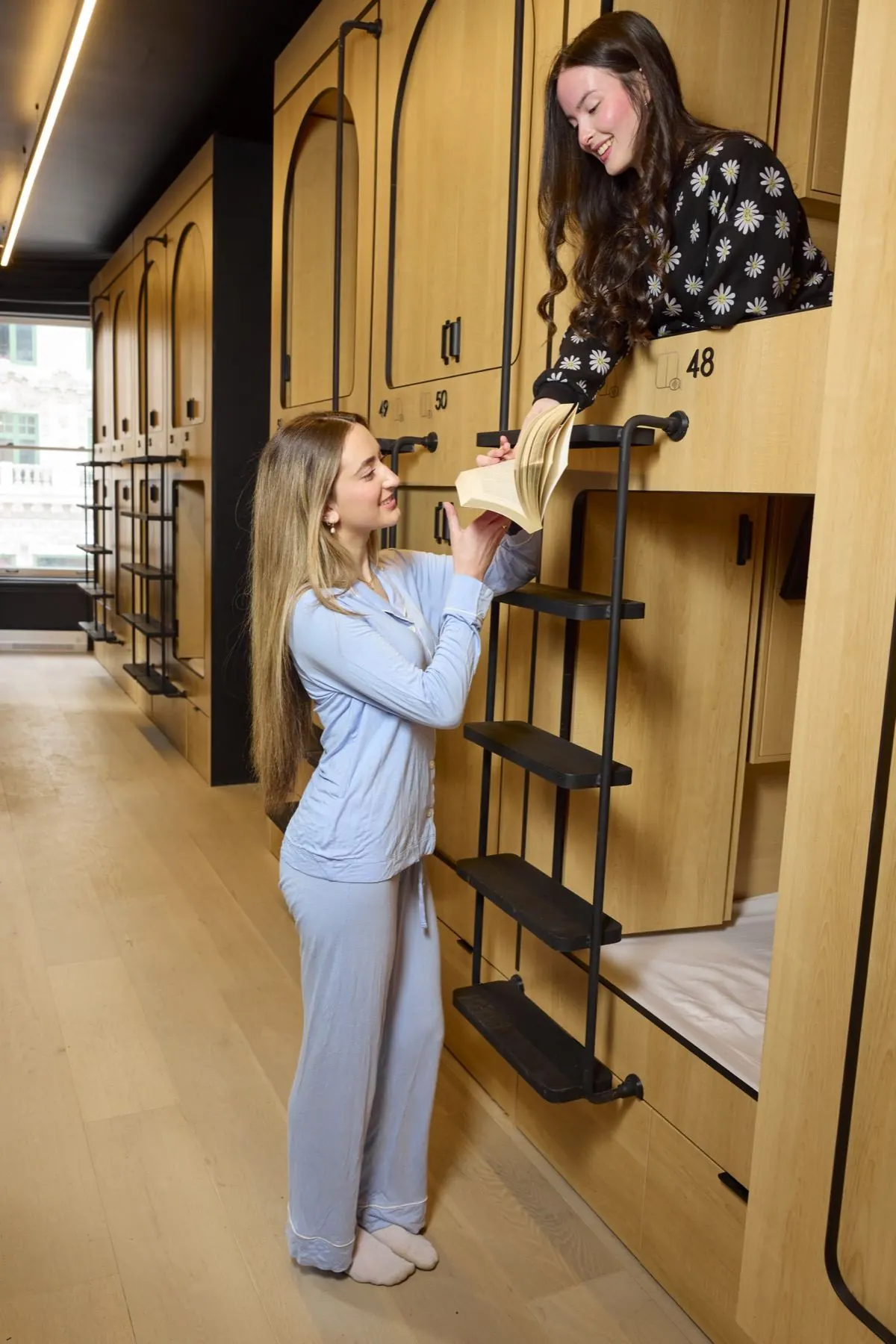
A capsule hotel is a strange in-between that happens to fit this exact situation. You get a private, enclosed pod with a real locking door — not a curtain — a personal locker big enough for a standard suitcase, an in-bed smart TV, USB and USB-C power, adjustable lighting and its own ventilation. The living parts are shared: kitchen, fridges, lounge, bathrooms.
For a student that means you can lock your laptop and passport in a locker and go to a campus appointment without carrying everything. For a backpacker it means you sleep behind a door instead of in an eight-bed dorm, for a price that's much closer to a dorm than to a hotel room. We compared the two properly in capsule hotel vs hostel.
What we'd rather tell you now than on arrival
- Bathrooms and showers are shared at every one of our properties. Private stalls, cleaned on a schedule — but shared.
- The kitchen is a common space, not your own. It's great for breakfast, coffee and a cheap dinner, which is most of what a student stay needs.
- Capsules are private and enclosed, but not soundproof. Pack earplugs if you're a light sleeper — true of capsule hotels everywhere.
- It's a bridge, not a lease. A capsule is an excellent way to spend two weeks apartment-hunting from a central address. It is not a substitute for an apartment once term is underway.
Backpackers: three nights, done properly
If you're passing through, the trick is to not spend your Montreal days on logistics. Land, drop your bag, walk. Our 48-hour budget itinerary is built for exactly this, and the metro and airport guide covers getting in from YUL without paying for a taxi you didn't need. If it's your first time in the city at all, ten things travelers wish they'd known will save you a couple of small mistakes.
A short checklist for your first week
- Book somewhere central for longer than you think you need — extending is easier than moving.
- Do your apartment viewings in person. Never wire a deposit for a place you haven't seen.
- Sort transit early; get whatever student fare you qualify for before the September rush.
- Find your grocery store, not your takeout place. Use the shared kitchen.
- Keep your documents in the locker, not in your bag.
Arriving with a group?
Exchange cohorts, sports teams and school trips book a block of capsules rather than scattered beds. Marie handles those directly at Marielechat@capsuleshotels.com — details on the groups page and in our group travel guide. For a longer solo stay, write to info@capsuleshotels.com and we'll quote it directly.
Land central, then find your apartment.
A private locking capsule downtown, a shared kitchen so you're not eating out twice a day, and a flat nightly rate with no cleaning fee. The price you see is the price you pay. Book direct at Capsule Residence Bishop.