
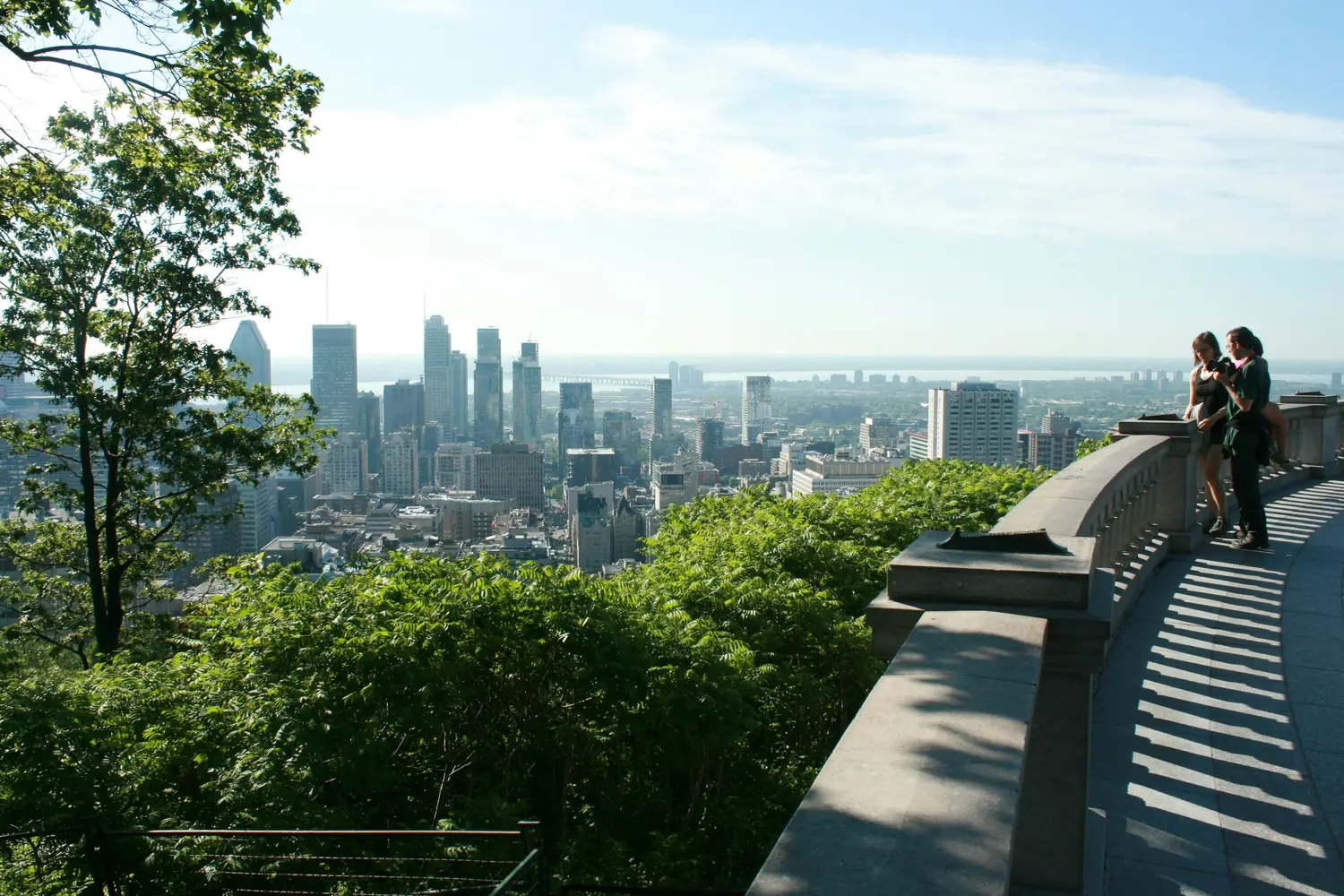
From late September into October, Quebec puts on the show people fly in for: maples going red, birch and poplar turning gold, whole hillsides changing in a week. You can get a preview on Mount Royal without leaving the city — we covered that in our guide to Montreal in the fall — but the full version is a day trip away. These are the ones we point guests to at the front desk, starting closest and working outward, with an honest note on which ones work without a car.
When the colour actually peaks
Colour moves south with the cold. The Laurentians and the higher parks usually turn first, from late September; the Eastern Townships and the hills of the Montérégie follow into early October; the island of Montreal tends to peak last, into mid-October. Every year shifts by a week or so with the weather, so treat that as a rough order, not a calendar. Sépaq and Quebec’s regional tourism sites post colour updates through the season — check them the week you go, not the month before.
One date worth knowing: Thanksgiving Monday falls on October 12 in 2026, and that long weekend is the busiest of the whole season on the roads and the trails. If you can go midweek, go midweek.
Mont Saint-Hilaire: the closest real hike
About forty kilometres east of the city, Mont Saint-Hilaire rises straight out of flat farmland, which is exactly why the view from the top is so good. The trails are in the Gault Nature Reserve, run by McGill University, with loops up to lookouts like Pain de Sucre and around Lac Hertel. It’s a proper half-day hike without being a technical one. The reserve manages access on busy days, so check its site before you head out.
The mountain is also ringed by orchards, and this is apple season. Pick-your-own farms and cider makers at the foot of the hill, and around nearby Rougemont, are the natural way to end the day.
Saint-Bruno and Oka: the easy half-days
Parc national du Mont-Saint-Bruno, on the South Shore, is the gentle option and the shortest trip on this list: small lakes, an old mill, and wide paths through maple woods. Parc national d’Oka, west of the city where the Ottawa River opens into the Lac des Deux Montagnes, pairs a beach you’ll mostly have to yourself in October with the Calvaire d’Oka trail and its view over the water.
Both are Sépaq parks, so a day-access fee applies, and on peak October weekends it’s worth reserving your access ahead rather than finding out at the gate.
The Eastern Townships: lakes, villages and wine
The Eastern Townships, roughly an hour and a half southeast, are the classic colour drive: rolling hills, covered bridges, lake towns like Magog and North Hatley, and villages like Sutton and Knowlton with good bakeries and antique shops. Parc national du Mont-Orford gives you the hiking; the Brome-Missisquoi wine route gives you a reason to stop every twenty minutes. This is the one that rewards a slow day with no fixed plan — which is also why it’s easiest with a car.
Tremblant and the Laurentians: the big one
If you only do one full day, a lot of people pick Tremblant, about an hour and a half to two hours north. The resort village usually runs its gondola through the colour season (check the operating days), and Parc national du Mont-Tremblant, beyond it, is enormous — lakes, waterfalls and a great deal of forest. On the way, Laurentian villages like Saint-Sauveur and Val-David are worth a stop, and the P’tit Train du Nord linear park, a former railway line turned bike and walking path, runs right through them.
Leave early. The drive back to Montreal on an October Sunday afternoon is part of local folklore, and not the good part.
Getting there without a car
Being car-free doesn’t rule any of this out, it just narrows the list:
- Commuter train. Saint-Bruno and Mont-Saint-Hilaire are both stops on exo’s commuter line out to Mont-Saint-Hilaire. The stations are not at the trailheads, so plan a taxi or a long walk for the last stretch, and check weekend service before you commit.
- Intercity coaches leave from the Gare d’autocars de Montréal, next to Berri-UQAM metro, toward the Eastern Townships and the Laurentians. Schedules change with the season, so look them up with the operator.
- Guided day tours run fall-colour trips from downtown in season, which solves the transport and the timing in one go.
- One day with a car. Montreal has car-sharing and plenty of rental counters downtown if you decide the Townships are worth it.
For the metro and bus side of things, see getting around Montreal; if you’re still planning how to arrive, start with getting to Montreal.
A colour day that actually works
- Check the colour updates the week you go, not before.
- Go midweek, or be on the road before 8 on a weekend — park lots can be full by mid-morning.
- Reserve park access ahead on peak weekends.
- Dress in layers: October mornings can sit near freezing even when the afternoon is warm. Bring a rain shell.
- Pack real food and water; snack bars in the parks keep shorter hours after summer.
- Be back for dinner — the fall festival calendar is still going in the evenings, and if the forecast turns, our rainy-day guide has the plan B.
A base in the city, not a cabin
The catch with renting a cottage up north is that you give up the city at night. Stay in Montreal and you get both: a day on the trails, then the Plateau or downtown in the evening. Our Capsule Hôtel Saint-Laurent is on the Main, in the middle of the evening. Our Capsule Residence Bishop is downtown, close to the metro and a few stops from the coach terminal. Our Capsule Hôtel + Vieux-Port in the Old Port is opening in 2026.
At either open property you get a private, enclosed capsule with a real locking door — not a curtain — a personal locker big enough for a standard suitcase, so the big bag stays behind while you head out with a daypack, plus an in-bed smart TV, USB and USB-C power and its own ventilation. The living space is shared on purpose: a lounge, a kitchen and fridges for the picnic you’re packing, and shared bathrooms with private showers for when you get back. Worth knowing before you book: capsules are private and enclosed, but they are not soundproof. For the honest comparison, see capsule hotels versus hostels.
Coming as a group?
Hiking clubs, school outdoor trips and teams book a block of capsules rather than scattered beds. Marie handles those directly at Marielechat@capsuleshotels.com — details on the groups page and in our group travel guide.
Out for the colours, home by dinner.
A private locking capsule, a shared lounge and kitchen, and a flat nightly rate with no cleaning fee. The price you see is the price you pay. Book direct with Capsule Hotels.