
Montreal is one of the easier North American cities to arrive in. The airport is close, the train station is downtown, the bus terminal sits on top of a metro station, and the whole central core is walkable once you're in it. The part travelers get wrong isn't reaching the city — it's the last twenty minutes, where a badly chosen taxi can cost more than a night in a capsule. Here's the whole picture, in order of how most people arrive.
By plane: Montréal–Trudeau (YUL)
Almost every international arrival lands at Montréal–Trudeau, about twenty kilometres west of downtown. It's a single-terminal airport, which means no inter-terminal shuttles and a short walk from customs to the exit doors.
From there, the default is the 747 airport shuttle: a public bus that runs 24 hours a day between the airport and downtown, ending at the Berri-UQAM terminal. You pay the price of a transit day pass, and that same pass then covers the metro and every other bus for the rest of the day — which is why it beats a taxi even on value alone if you're heading anywhere central. Buy it at the machines in the arrivals hall before you board; the driver doesn't sell tickets.
A taxi or rideshare to downtown runs on a fixed flat fare rather than the meter, currently around CA$50 before tip. Worth it if you land at 2am with three bags and no patience; hard to justify otherwise, since the 747 does the same trip for a fraction of it.
By train: Gare Centrale
The train is the underrated option in this corridor. VIA Rail runs into Gare Centrale, which is not on the edge of the city — it's directly under downtown, connected to the underground city and to Bonaventure metro station.
- From Toronto — roughly five hours, several departures a day, and you arrive in the middle of the city rather than at an airport.
- From Ottawa — about two hours. The single easiest intercity trip in the country.
- From Quebec City — a little over three hours, and a genuinely scenic ride along the river.
- From New York — Amtrak's Adirondack route connects the two cities when it's running; check current service before you plan around it, as the schedule has changed more than once in recent years.
If you're arriving by train, Capsule Residence Bishop is the obvious base: it's a fifteen-minute walk from Gare Centrale, or one short metro hop if it's raining.
By bus: Gare d'autocars de Montréal
The intercity bus terminal is at 1717 Berri, sitting directly on top of Berri-UQAM — the station where three metro lines meet. It's the single best-connected arrival point in the city, and it's also where the 747 from the airport ends its run.
Carriers and schedules change often enough that we won't list fares here, but the bus is reliably the cheapest way in from Quebec City, Ottawa and Toronto, and often the only late-night option. If your budget is the reason you're reading this, the bus in and a capsule to sleep in is the cheapest serious version of a Montreal trip.
Arrive central, and the city stops costing you money to get around.
By car — and why you may not want one
Driving in is easy. Parking is the expensive part. Central Montreal is a mix of metered street parking, permit-only residential zones and private lots, and a car parked downtown for three nights can quietly cost more than the room it's parked near. Add winter parking restrictions between roughly December and March, and the sums get worse.
Our honest advice: if you're coming from within a few hours' drive and staying in the centre, take the train or the bus. If you do drive, plan on a paid lot rather than street parking, and then leave the car there — the neighborhoods you came to see are better on foot, and the metro is faster than you are.
Crossing the border
If you're flying or driving in from outside Canada, check the entry requirements that apply to your passport on the official Government of Canada website before you book anything. Requirements differ by nationality and by how you arrive, they change, and no blog post is the right source for them — including this one.
From your arrival point to your capsule
Here's the last mile, which is the bit nobody writes down.
- Airport → Bishop (downtown). 747 to downtown, then a short walk. Bishop is in the heart of the centre-ville, close to the metro, the museums and Concordia.
- Airport → Saint-Laurent (Plateau). 747 to Berri-UQAM, one stop on the green line to Saint-Laurent station, then a walk up the Main. Your day pass covers all of it.
- Gare Centrale → Bishop. Fifteen minutes on foot, mostly through downtown; or Bonaventure to Guy-Concordia if you'd rather not walk.
- Bus terminal → Saint-Laurent. You're already on the green line. It's a very short trip.
For everything after arrival — how the metro fares work, when a bus beats a walk, what a Bixi costs — our getting-around guide is the companion piece to this one.
Late arrivals, early departures
Buses and flights don't respect check-in windows, and we don't expect them to. Arriving late is normal here: come in quietly, and the floor stays asleep. If you land before your capsule is ready, drop your bag and go eat something — that's what the shared lounge is for, and our food guide has the short list near each address.
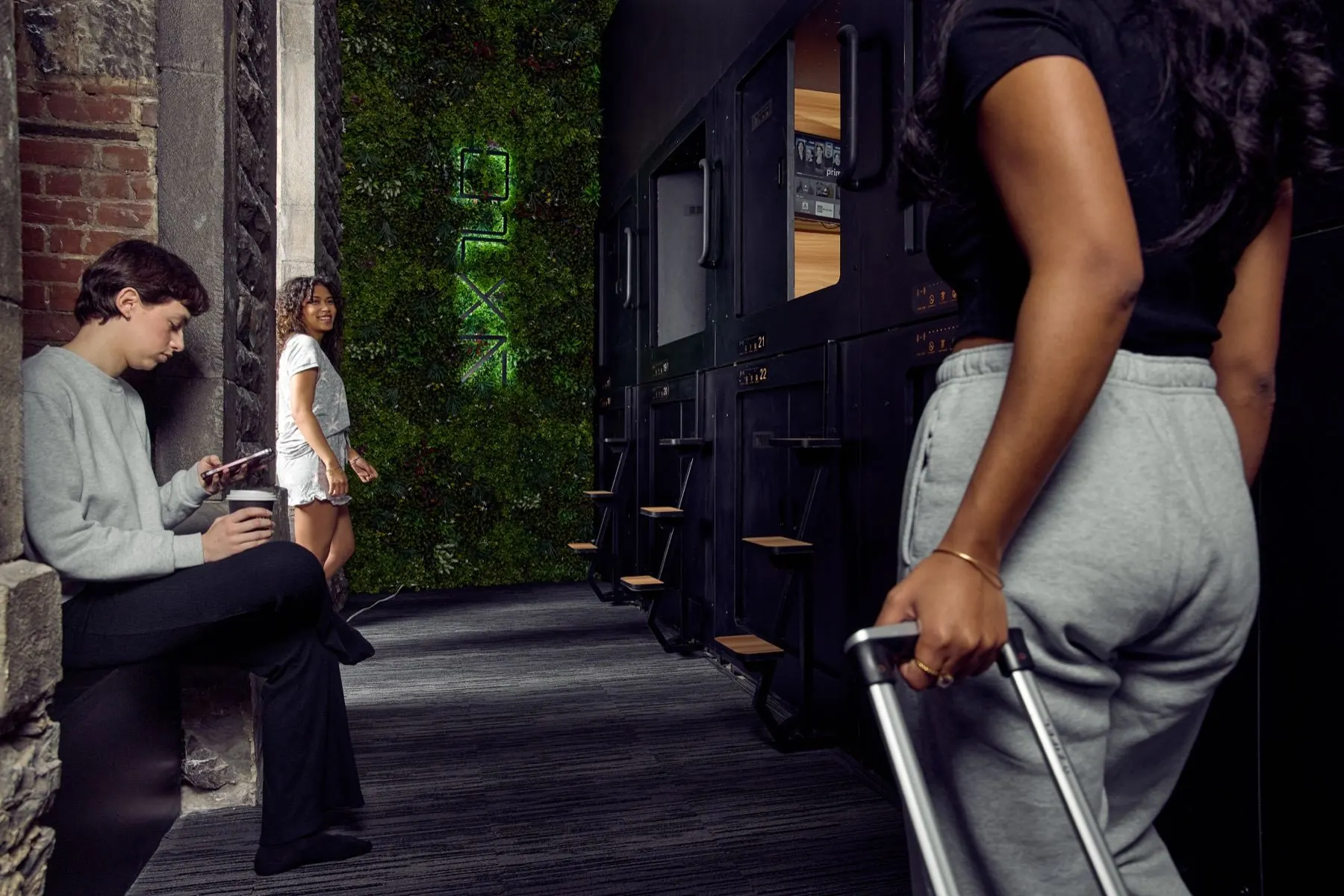
One practical note for early departures: a capsule has a real locking door, an in-bed smart TV and a locker big enough for a standard suitcase, but it isn't soundproof. Do the loud half of your packing the night before your 6am flight and everyone on the floor will thank you. The full list of small habits is in our capsule etiquette guide.
Arriving as a group
School trips, sports teams, production crews and wedding parties arrive on one bus and need one point of contact. That's Marie — write to Marielechat@capsuleshotels.com, or start from our groups page. The full breakdown of how a group block works is in our group travel guide.
Where to point the taxi
All three addresses are central, so the arrival is short from anywhere. Saint-Laurent puts you on the Plateau among the cafés and the nightlife. Bishop is downtown, closest to Gare Centrale and the metro — the easiest one to reach with luggage. Old Port is the cobblestone end of the city, opening in 2026. Undecided? Start with our neighborhood guide.
Land, walk in, sleep.
A private locking capsule in central Montreal, a suitcase-sized locker, and shared spaces worth spending time in. Book direct from CA$55 a night — best rate, no middleman.